Okay this is the post I said I was going to write forever ago. Back in February I participated in an archaeological dig for credit. For three weeks I went to the dig site Sunday through Thursday 7am-3pm. The site I was at is across the street from the City of David. It is called the Givati excavation. Givati is the name of the parking lot they are digging up. They have been digging at this site for several years now and every year the parking lot gets smaller and smaller.
Every morning I took the train down the the Damascus gate of the Old city. I walked straight through the Old city and exited at the Dung Gate on the other side. Because the dig started at 7am I was usually walking through the Old city around 6:30am. Not much is open that early in the morning unless the shop sells pastries, coffee or newspapers they won't open until later in the morning when the tourists arrive. Not many people get to experience the Old city that early in the morning so one day I took my camera with me. It was raining that morning and they cancelled the dig that day. It's no fun trying to dig in mud. So for the rest of that morning Annie and I walked around the city and took pictures.
First I will take you on my route from Damascus gate to the other side of the Old city. To the left is Damascus gate.
This is just inside the gate. I know this picture isn't very exciting. I plan to go back to the city in the afternoon when everything is open and walk the same route to show how busy the Old city gets.
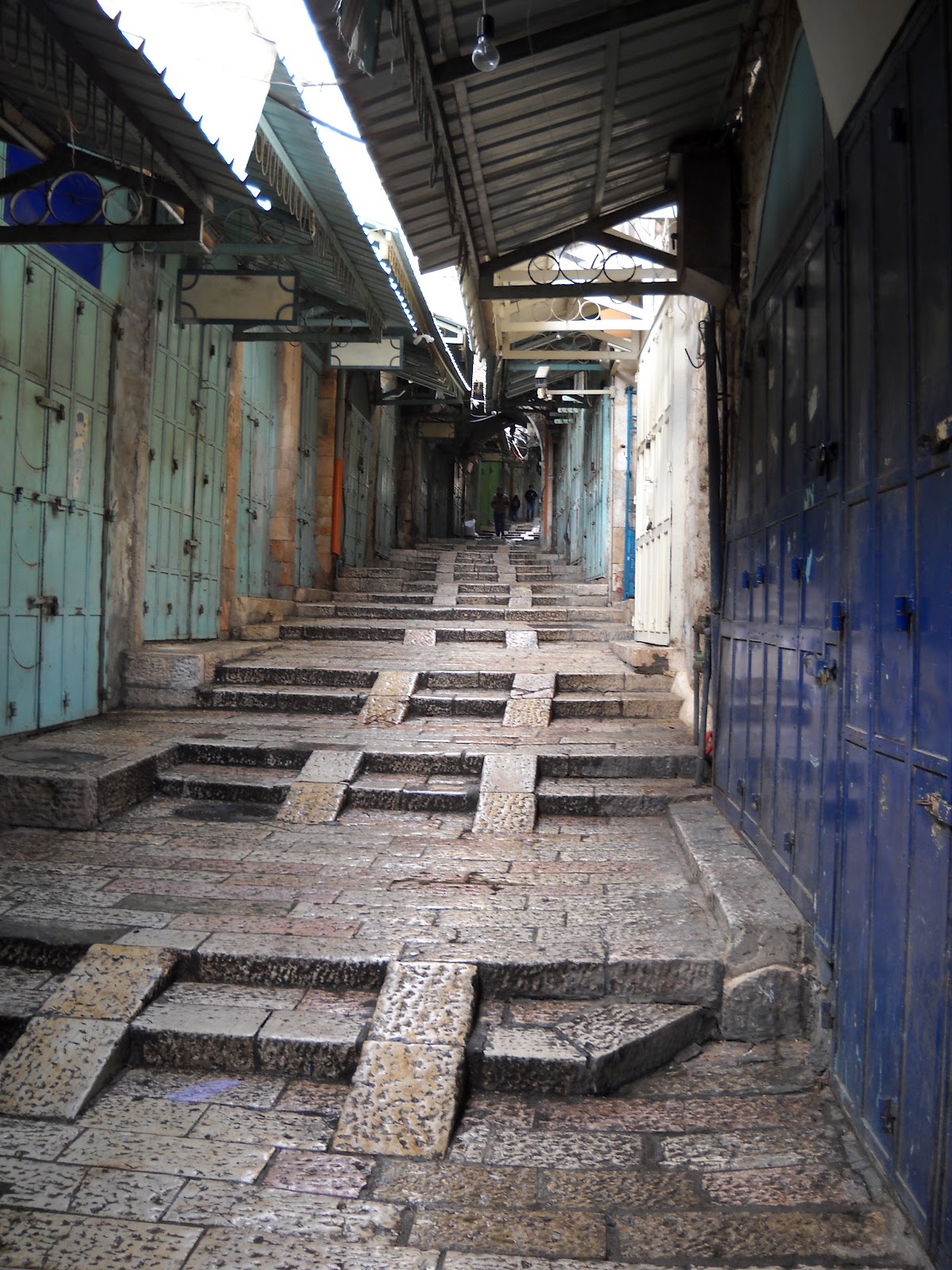
Here I've just turned the corner. The paving stones are very slippery when wet. So walking through the Old city on a rainy day is a slip n' slide adventure. Wear shoes with good traction and even then be careful.
I've walked several feet forward here. The green door on the left side of this picture is the location of my favorite falafel stand in the city.
There are paths on either side of the falafel stand above. Here I took the path to the left. The metal doors are openings to shops.
Further down the path. Notice the sign above the arch is in Arabic. This is the Arab quarter of the Old city.
I'm early enough in the morning that children are still heading out to catch the bus to school.
Here I wanted you to see the different sizes of paving stones. The larger stones in the middle are the oldest ones.
As narrow as some of these areas are people still drive cars around in the Old City. In some places when a car is coming you have to press your back up against the wall and turn your feet sideways to let the car pass.
I had a few pictures that didn't turn out too good because of the rain. This is the next good one.
Notice the street sign in the upper left corner. This is how you know where you are in the Old city. However I'm directionally challenged and I still get lost pretty easily inside the old city walls.
This gives you an idea of how close the shops are to each other.
Notice the bags of bread hanging on the door to the right of the picture. The owner of this shop has an arrangement with one of the bakeries to sell some of their bread. They just hang the morning delivery on the door and no one bothers it.
The Western wall. This is as empty as you will ever see it.
Here I have exited through the Dung Gate. Straight ahead of me is the Mount of Olives. Notice the curved tents to the right of the picture this is the dig site.
A closer look at the dig site. You can see where the level of the parking lot used to be and how far down they are now.
This picture shows you the areas they have already excavated. There are two videos on youtube of my professor giving a lecture to tourists about their findings. These videos are from a few years ago but they are still interesting. Here is part 1 and part 2
This is the Dung Gate going back into the city after they told us we were not digging that day.
This is the picture that everyone who has ever been here has taken. This picture is in all the guidebooks.
I have no idea what this is but it looks cool.
The next few pictures are random streets in the Old City.
I knelt down to get this picture.
The stairs. There are several places in the Old city that look like this. The ramps are the width of the wheeled carts they bring down to restock the stores.
I think this was around 8:30am. Some of the stores were starting to open up. I've decided to split the city tour into two posts since I took 139 pictures that morning. I'm having a hard time narrowing down which ones to show.
Saturday, May 12, 2012
Friday, March 2, 2012
Snow!
Hello everyone. I know it's been forever since I posted. The fall semester is finished and the Spring semester starts this coming Sunday. The last three weeks were my winter break. Instead of going home this year I decided to stay here in Jerusalem. I spent these three weeks volunteering at an archaeological dig here in the city. I will be posting about that experience soon.
Today's post is a little more breaking news. Today it's snowing in Jerusalem. Here is an article in the Jerusalem post. The snow is a big deal here since it hasn't snowed the last several years. And since I'm from Texas I don't see snow too often either.
I woke up this morning around 8am and this is what I saw outside the kitchen window. It doesn't look too terribly impressive but I was excited to see it. When I went to the grocery store around 9am it had started to snow harder. The grocery store was busier than it would normally be this early on a Friday morning. After putting away my groceries I got my camera and went for a walk.
This is a view from the opposite side of my building. Normally you can see the Dome of the Rock from here but the snow is obscuring the view.
This picture gives you an idea of the size of the snowflakes.
There were a lot of smiling people out this morning. Here some students made a snowman. I was only intending to circle around the student village and then go back inside. But I decided to stop by the mail room and I had a package slip. So I decided to see if the post office was open. Plus it was an opportunity for more pictures.
Here I've gone up past the grocery store and turned right and then left.
A look back and the dorms I just came from.
Snow covered houses. When I arrived at the post office a guy standing outside told me it was close. As I started to walk away he asked me what I needed from the post office. I told him I wanted to pick up a package. He said he could get it for me so I gave him my package slip and received my package. On my walk back home the sun came out and the sky cleared up a bit. Several snow plows passed by I think I saw six total on the entire walk.
Back in the student village standing almost in the same place as the earlier picture you can now see the Dome of the Rock. The sky has since clouded over again but now it is just raining. Oh well the snow was fun while it lasted.
Today's post is a little more breaking news. Today it's snowing in Jerusalem. Here is an article in the Jerusalem post. The snow is a big deal here since it hasn't snowed the last several years. And since I'm from Texas I don't see snow too often either.
I woke up this morning around 8am and this is what I saw outside the kitchen window. It doesn't look too terribly impressive but I was excited to see it. When I went to the grocery store around 9am it had started to snow harder. The grocery store was busier than it would normally be this early on a Friday morning. After putting away my groceries I got my camera and went for a walk.
This is a view from the opposite side of my building. Normally you can see the Dome of the Rock from here but the snow is obscuring the view.
This picture gives you an idea of the size of the snowflakes.
There were a lot of smiling people out this morning. Here some students made a snowman. I was only intending to circle around the student village and then go back inside. But I decided to stop by the mail room and I had a package slip. So I decided to see if the post office was open. Plus it was an opportunity for more pictures.
Here I've gone up past the grocery store and turned right and then left.
A look back and the dorms I just came from.
Snow covered houses. When I arrived at the post office a guy standing outside told me it was close. As I started to walk away he asked me what I needed from the post office. I told him I wanted to pick up a package. He said he could get it for me so I gave him my package slip and received my package. On my walk back home the sun came out and the sky cleared up a bit. Several snow plows passed by I think I saw six total on the entire walk.
Back in the student village standing almost in the same place as the earlier picture you can now see the Dome of the Rock. The sky has since clouded over again but now it is just raining. Oh well the snow was fun while it lasted.
Sunday, January 1, 2012
Happy New Year!
New Years isn't really celebrated over here like it is in the United States. If you recalled the Jewish New Year was back on September 22nd this year.
In the Southern Part of the United States we have a tradition of eating black eyed peas for good luck in the New Year. I discovered that we may get this tradition from Jewish tradition. According to the Talmud
“Now that you have alleged that omens make a difference, at the New Year, someone should form the habit of eating pumpkin, fenugreek, leeks, beets, and dates.”
The tradition of eating black eyed peas comes from the mistranslation of the Aramaic word rubiya. It actually translates as fenugreek. Which I had to look up because I've never heard of it. By the time the mistranslation was discovered the tradition of black eyed peas was already in place. This tradition reached the United States in the 1730's when a group of Sephardic Jews immigrated to Georgia. The practiced was adopted by non-Jews around the time of the Civil War. And like all good Southern vegetable dishes we added some form of pork to it, either as flavoring in the beans or as the main dish served with them.
Another tradition says we eat the black eyed peas because of the Union General Sherman know for his march to the sea. As he marched through Georgia burning everything the theory is that the Union soldiers would not have burned or carried away the beans. In the North the beans were seen as food for animals and the soldiers wouldn't have touched them. General Sherman captured the city of Savannah on December 21, 1864 and offered it to President Lincoln as a Christmas present. So it is possible that the beans were eaten on New Years because there was nothing else left to eat.
Either theory for how the tradition started sounds plausible to me.
Saturday, December 24, 2011
It's Christmas time in the city
Yesterday I went to Bethlehem with Claire and two other friends from school. It was a wonderful trip to get into the Christmas spirit. Because there is Christmas in Bethlehem because of the Arab Christians and the tourist industry.
Claire made small talk with our cab driver that was taking us to the center of the city. She asked him if he knew a good place to buy olive wood souvenirs that were of a reasonable price. Of course he said yes he had some friends with a shop. So instead he drove us to his friends shop.
He took us to see the factory where the olive wood pieces are carved. The man was only actually carving one piece and the machine mimicked his movements on the other pieces. Our taxi driver is the man in the orangish red shirt. After seeing the factory he took us to the shop up above. The hospitality of the shop was wonderful we were each given Turkish coffee to drink while we shopped. We also got a discount since their friend brought us to the shop.
One of the things I knew I wanted was an olive wood nativity scene. The more detailed the piece the more expensive it was. I managed to find a small one that was in my price range.
I also found a nice angel as well as a small cross.
Next we visited the square where it really felt like Christmas. Well sort of...note the mosque in the background with the picture of Yasser Arafat.
They were setting up a stage for live performances that will take place today. Notice how December is spelled on the banner. :)
On the other side of the square from the mosque is the Basilica of the Nativity. This is the oldest continuously used church in the world. It was originally built by Queen Helena, Emperor Constantine's mother in the 300's. It's been destroyed and rebuilt many times since then.
This is the Door of Humility you have to duck down in order to get through the door.
It opens up into a large area with vaulted ceilings.
Notice the open spot in the floor in the picture above. This is left open to show you pieces of the original floor from the church Saint Helena built.
This is the Orthodox part of the church. Like the Holy Sepulchre the Basilica of the Nativity is divided up between several denominations.
Wall decorations that are from an earlier version of the church.
This is standing in line to visit the Grotto of the Nativity. It was rather claustrophobic standing in the line. There were several tour groups in line and their guides were explaining the history of the church. The group behind us was an English group so I listened in for free. There was also a Russian tour group in line.
A rare picture of Mary smiling.
The narrow opening down into the Grotto.
The priests were hurrying people through since the line was so long. This is the best picture I could get of the place where Jesus was born.
This is a Nativity scene in a courtyard area. Those are stuffed sheep.
We then walked about two hundred meters to another church that I had never heard of before. The Milk Grotto church. The legend has it that this church is built over a cave that the Holy family hid while fleeing from Herod into Egypt. While Mary was breast feeding Jesus Mary's milk fell and whitewashed the rocks which is why the rocks inside the church are white.
It was lunch time so we went to get coffee. It looks vaguely familiar. ;) We then went back to the square and had falafel at Afteem a famous falafel place in Bethlehem.
After lunch we went shopping again. I bought myself a scarf.
Claire made small talk with our cab driver that was taking us to the center of the city. She asked him if he knew a good place to buy olive wood souvenirs that were of a reasonable price. Of course he said yes he had some friends with a shop. So instead he drove us to his friends shop.
He took us to see the factory where the olive wood pieces are carved. The man was only actually carving one piece and the machine mimicked his movements on the other pieces. Our taxi driver is the man in the orangish red shirt. After seeing the factory he took us to the shop up above. The hospitality of the shop was wonderful we were each given Turkish coffee to drink while we shopped. We also got a discount since their friend brought us to the shop.
One of the things I knew I wanted was an olive wood nativity scene. The more detailed the piece the more expensive it was. I managed to find a small one that was in my price range.
I also found a nice angel as well as a small cross.
Next we visited the square where it really felt like Christmas. Well sort of...note the mosque in the background with the picture of Yasser Arafat.
They were setting up a stage for live performances that will take place today. Notice how December is spelled on the banner. :)
This is the Door of Humility you have to duck down in order to get through the door.
It opens up into a large area with vaulted ceilings.
Notice the open spot in the floor in the picture above. This is left open to show you pieces of the original floor from the church Saint Helena built.
This is the Orthodox part of the church. Like the Holy Sepulchre the Basilica of the Nativity is divided up between several denominations.
Wall decorations that are from an earlier version of the church.
This is standing in line to visit the Grotto of the Nativity. It was rather claustrophobic standing in the line. There were several tour groups in line and their guides were explaining the history of the church. The group behind us was an English group so I listened in for free. There was also a Russian tour group in line.
A rare picture of Mary smiling.
The narrow opening down into the Grotto.
The priests were hurrying people through since the line was so long. This is the best picture I could get of the place where Jesus was born.
This is a Nativity scene in a courtyard area. Those are stuffed sheep.
We then walked about two hundred meters to another church that I had never heard of before. The Milk Grotto church. The legend has it that this church is built over a cave that the Holy family hid while fleeing from Herod into Egypt. While Mary was breast feeding Jesus Mary's milk fell and whitewashed the rocks which is why the rocks inside the church are white.
It was lunch time so we went to get coffee. It looks vaguely familiar. ;) We then went back to the square and had falafel at Afteem a famous falafel place in Bethlehem.
After lunch we went shopping again. I bought myself a scarf.
Monday, November 7, 2011
Strike! Strike?
From what I understand this strike is about government contract workers. We discussed the strike this morning in Modern Hebrew class which means some of this information may not be entirely correct as I received it in Hebrew. From my understanding the contract workers do not receive benefits and receive less pay. In their situation there is no chance for advancement to better pay and benefits.
The strike was supposed to shut down airports, seaports, mass transportation, government offices and universities. The emails I received said that even if there was a general strike classes would still be held at Rothberg I guess because we are separate from the main university.
There was a strike this morning but it was only from 6am to 10am. Why? Because a judge limited the strike. I am so confused about this. I don't understand what is the point of a strike if a judge can tell you to limit the hours? Currently the Finance Ministry is in talks with Histadrut and they have to report back to the judge on Thursday. So if the talks fall through there is a potential of a strike on Thursday. Histadrut is one of the big labor unions in Israel. This was an interesting lesson to have this morning in Hebrew.
Saturday, October 8, 2011
Day of Atonement (Yom Kippur)
Today is Yom Kippur (day of atonement) it began yesterday at sunset. I wrote a pretty lengthy post about this holiday last year. My Yom Kippur post from last year is the most popular post on this blog in terms of page views.
In the Bible the holiday is discussed in Leviticus 16, Leviticus 23, and Numbers 29. These links will also show you the verses in Hebrew. I think the book of Jonah is traditionally read on this holiday. In the book of Jonah the people of Nineveh are given the chance to repent of their sins. Yom Kippur is about forgiveness and new beginnings.
I wanted to discuss what this holiday looked like in the times of the Temple and why this is the holiest day of the year on the Jewish calendar. Temples in the ancient world were different from synagogues and churches of today. In the ancient world temples were seen as the dwelling place of the god on earth. Since the building was holy only priests were allowed to enter. The sacrifices actually took place on an altar outside the Temple. Only the priests were allowed inside the Temple building itself. The Temple itself has three sections the Ulam (porch), the hechal(place of the altars of incense and tables of show bread), and the Dvir (Holy of Holies). The Holy of Holies was the place the ark of the covenant was kept. Only the high priest could enter the Holy of Holies and only on one day of the year...Yom Kippur. There was a fairly complex ritual involved for the high priest that is discussed in this article scroll down a bit to find it. This was the day that the name of the Lord was pronounced three times by the high priest. I believe this was the only time of year that the name of the Lord was pronounced and only by the High priest. Today no one is sure how to pronounce the name of the Lord since only the High priest knew. I think the knowledge was lost when Hadrian rebuilt Jerusalem and forbid the Jews from entering there was no Temple and no High priest and the knowledge was lost.
You can read about the building of the first Temple by Solomon in 1 Kings 6. And here is a picture of a model of the Second Temple built by King Herod that is on display at the Israel museum.
In the Bible the holiday is discussed in Leviticus 16, Leviticus 23, and Numbers 29. These links will also show you the verses in Hebrew. I think the book of Jonah is traditionally read on this holiday. In the book of Jonah the people of Nineveh are given the chance to repent of their sins. Yom Kippur is about forgiveness and new beginnings.
I wanted to discuss what this holiday looked like in the times of the Temple and why this is the holiest day of the year on the Jewish calendar. Temples in the ancient world were different from synagogues and churches of today. In the ancient world temples were seen as the dwelling place of the god on earth. Since the building was holy only priests were allowed to enter. The sacrifices actually took place on an altar outside the Temple. Only the priests were allowed inside the Temple building itself. The Temple itself has three sections the Ulam (porch), the hechal(place of the altars of incense and tables of show bread), and the Dvir (Holy of Holies). The Holy of Holies was the place the ark of the covenant was kept. Only the high priest could enter the Holy of Holies and only on one day of the year...Yom Kippur. There was a fairly complex ritual involved for the high priest that is discussed in this article scroll down a bit to find it. This was the day that the name of the Lord was pronounced three times by the high priest. I believe this was the only time of year that the name of the Lord was pronounced and only by the High priest. Today no one is sure how to pronounce the name of the Lord since only the High priest knew. I think the knowledge was lost when Hadrian rebuilt Jerusalem and forbid the Jews from entering there was no Temple and no High priest and the knowledge was lost.
You can read about the building of the first Temple by Solomon in 1 Kings 6. And here is a picture of a model of the Second Temple built by King Herod that is on display at the Israel museum.
Friday, October 7, 2011
The Negev
I took this tour back on September 27th. The Negev is the name given to the desert region in the Southern part of Israel. We left the student village around six in the morning and drove for a couple of hours to get there. We hiked in the desert for about five hours I think. It was exhausting. For those who know me you know I'm not much of an outdoors girl. However I wanted to see the desert and I knew I could get some good pictures for the blog. I took a lot of pictures and its hard to narrow it down so be prepared for another really long post.
This was our first challenge. Notice the pathway to the right of the picture? We climbed that. This climb was as bad if not worse that the Masada climb of last Summer.
We did make it to the top. That is the rest of the group in front of me. You see I suffer from seasonal asthma I only have it in the Spring and the Summer. Most of the time it doesn't really affect me. However on this day it was really bad and I did not have my inhaler with me because again it's usually not a problem. There was a lot of sand in the air that day and I spent most of the hike gasping for air towards the back of the group.
This is the view from the plateau towards the left of the previous picture. Notice the different colors of the rock. This desert has a lot of sedimentary rock because in ancient times this was the seabed. There are lots of shells laying around.
This is the view from the right side of the plateau above. Notice the line of shrubs it marks the area of a dry river bed. There is only water in it during the winter rains. I believe this is called the Zin Valley.
This is the area straight ahead. There is a kibbutz over there called Sde Boker famous because it is where David Ben Gurion retired. I'll speak more about him later.
Our guide pointed out these ibex on a nearby cliff. I thought this was a close as I would get to the ibex but I was wrong.
A desert plant in bloom. Notice that only the middle is currently blooming. There aren't many animals in the desert and the plant wants to maximize pollination so it blooms in stages over several weeks. The bottom blooms first then the middle. I forget what the name of this plant. In Biblical times it was used to mark the boundaries of a person's land because it always came up in the same spot every year.
After walking about an hour we came across a refreshment stand. I was so surprised. It is run by a group of Bedouins. They were selling an assortment of drinks. You could also pay to take a nap on one of the bedrolls.
Still at the back of the group. This is a perspective picture to show you how small I felt walking in this desert.
Walking at the back of the group you could get a sense of what it must have been like to cross the desert in ancient times. It seems to stretch on forever.
Just before we stopped for lunch we came across this guy. I felt like a National Geographic photographer getting this picture.
We stopped for lunch at an oasis. There were a few locals already there swimming in the water. I wouldn't want to swim in it it's full of algae. This water has been sitting here since the rainy season last winter.
I didn't take many pictures after lunch everything was beginning to look the same. After lunch we hiked back to the bus. Then we went to Midreshet Ben-Gurion. This is the location where David Ben Gurion is buried there is also Institute there dedicated to studying his works. Ben Gurion was the first Prime Minister of Israel he is a very important figure in the history of Israel. He believed that the Negev is the future of Israel. He believed that when the major cities got too crowded people would move down into the Negev.
I didn't expect there to be so many ibex in this area. This is a female notice her horns are smaller. She was standing so still that at first I thought she was a statue until she blinked. Then I thought maybe she was used to having her picture taken and was posing for me.
Awww Baby!
I'm not an expert but I'm going to say this is a juvenile male based on the thickness of the horns.
We were picking the seed pods off the trees and throwing them trying to get them to stay for pictures. I managed to catch her with a seed pod hanging out of her mouth like a cigar.
Here I took a series of pictures and pasted them together using Photoshop. This is looking out on the area where we hiked earlier in the day. I believe we started the hiked around 8:30am and we got back to the bus around 4:30pm. I was exhausted by the end of the day and I had a migraine from the strength of the sun. My asthma was so bad it felt like I was trying to suck air through a coffee stir. I slept like a rock that night. I think I still have half the sand of the desert in my lungs. It was worth it for the pictures, aren't they pretty?
This was our first challenge. Notice the pathway to the right of the picture? We climbed that. This climb was as bad if not worse that the Masada climb of last Summer.
We did make it to the top. That is the rest of the group in front of me. You see I suffer from seasonal asthma I only have it in the Spring and the Summer. Most of the time it doesn't really affect me. However on this day it was really bad and I did not have my inhaler with me because again it's usually not a problem. There was a lot of sand in the air that day and I spent most of the hike gasping for air towards the back of the group.
This is the view from the plateau towards the left of the previous picture. Notice the different colors of the rock. This desert has a lot of sedimentary rock because in ancient times this was the seabed. There are lots of shells laying around.
This is the view from the right side of the plateau above. Notice the line of shrubs it marks the area of a dry river bed. There is only water in it during the winter rains. I believe this is called the Zin Valley.
This is the area straight ahead. There is a kibbutz over there called Sde Boker famous because it is where David Ben Gurion retired. I'll speak more about him later.
Our guide pointed out these ibex on a nearby cliff. I thought this was a close as I would get to the ibex but I was wrong.
A desert plant in bloom. Notice that only the middle is currently blooming. There aren't many animals in the desert and the plant wants to maximize pollination so it blooms in stages over several weeks. The bottom blooms first then the middle. I forget what the name of this plant. In Biblical times it was used to mark the boundaries of a person's land because it always came up in the same spot every year.
After walking about an hour we came across a refreshment stand. I was so surprised. It is run by a group of Bedouins. They were selling an assortment of drinks. You could also pay to take a nap on one of the bedrolls.
Still at the back of the group. This is a perspective picture to show you how small I felt walking in this desert.
Walking at the back of the group you could get a sense of what it must have been like to cross the desert in ancient times. It seems to stretch on forever.
Just before we stopped for lunch we came across this guy. I felt like a National Geographic photographer getting this picture.
We stopped for lunch at an oasis. There were a few locals already there swimming in the water. I wouldn't want to swim in it it's full of algae. This water has been sitting here since the rainy season last winter.
I didn't take many pictures after lunch everything was beginning to look the same. After lunch we hiked back to the bus. Then we went to Midreshet Ben-Gurion. This is the location where David Ben Gurion is buried there is also Institute there dedicated to studying his works. Ben Gurion was the first Prime Minister of Israel he is a very important figure in the history of Israel. He believed that the Negev is the future of Israel. He believed that when the major cities got too crowded people would move down into the Negev.
I didn't expect there to be so many ibex in this area. This is a female notice her horns are smaller. She was standing so still that at first I thought she was a statue until she blinked. Then I thought maybe she was used to having her picture taken and was posing for me.
Awww Baby!
I'm not an expert but I'm going to say this is a juvenile male based on the thickness of the horns.
We were picking the seed pods off the trees and throwing them trying to get them to stay for pictures. I managed to catch her with a seed pod hanging out of her mouth like a cigar.
Here I took a series of pictures and pasted them together using Photoshop. This is looking out on the area where we hiked earlier in the day. I believe we started the hiked around 8:30am and we got back to the bus around 4:30pm. I was exhausted by the end of the day and I had a migraine from the strength of the sun. My asthma was so bad it felt like I was trying to suck air through a coffee stir. I slept like a rock that night. I think I still have half the sand of the desert in my lungs. It was worth it for the pictures, aren't they pretty?
Subscribe to:
Posts (Atom)