Friday, September 30, 2011

Tour of Ein Kerem

Before I get into the tour I took back on September 22nd I wanted to talk about the holiday Rosh Hashanah or the Jewish new year. The holiday began Wednesday at sun set and yesterday was new year's day. You can read my post from last year here. I mention the pomegranate is traditionally eaten on this holiday along with apple slices dipped in honey. This year I discovered why the pomegranate is eaten.The abundance of seeds represents fruitfulness and the myth is that each fruit has 613 seeds which represent 613 mitzvot. Mitzvot are like commandments you can read about them here. Everything shuts down for this holiday and most of the students go home to spend the holiday with their families. It is very quiet here in the student village. I wanted to share a new year song they taught us in class it's very catchy and will get stuck in your head. This rendition is very sad sounding I've never heard this arrangement before. The second one is more upbeat and closer to the version they taught us at school.

Now on to the tour. Ein Kerem means spring of the vineyard according to my translation. This is the traditional site where John the Baptist was born. In ancient times it was far from Jerusalem. Today it is part of Jerusalem. It is mentioned in the Bible as Beth Hakerem in Jeremiah 6:1 and Nehemiah 3:14. I took 117 pictures on this tour be prepared for a long post. I narrowed down the pictures to show you but there are still quite a few.


This is the Church of the birth place of Saint John the Baptist.  There is a nice staircase leading up to the door but I couldn't back up far enough to get the entire building in one picture. This church is owned by the order of Franciscan monks.


This picture is to the right of the previous picture. You are looking at an archaeological site. In Israel holy sites tended to get reused by different religions. This is the remains of a temple to the goddess Venus/Aphrodite. A statue of the goddess was found at this site but it is currently in a museum. I forget which one.


This picture is just before you enter to church it's a cut out in the floor to an earlier Byzantine church. The message is in Greek (I think) and it says All hail the innocent martyrs. The martyrs it refers to are the babies that King Herod ordered killed in order to prevent the Messiah from coming.


We were touring the church around prayer time so as we walked through the church we listened to the nuns singing and praying.


This is the cave area that is where John the Baptist was born.


A peek into someones garden as we were walking through the village. The houses and gardens are beautiful in this area.


Next we visited Notre Dome of the Sisters of Sion. I never would have found this place on my own. It has high walls around it. Ring the bell and tell them you want to visit the garden, it requires a two shequel donation but its totally worth it. It's very peaceful inside. They do have a guest house that you can stay in. We visited for the beautiful views and the cemetery. This is the grave of the monk who founded the place. I can't remember his name. He was originally Jewish but he had a powerful vision of Mary in the position depicted in the statue with glowing hands and he converted to Christianity. Notice the stones placed on the grave. This is a Jewish tradition when you visit a grave you leave a stone behind instead of flowers. There are several different stories as to why you leave a stone. One is that the stone represents earth, the idea of ashes to ashes dust to dust we will all return to the earth one day. The other story I've heard is that the stone represents a part of you that you leave at the grave to honor the deceased.


This is an ossuary from 2,000 years ago. The current cemetery is on the location of a cemetery from 2,000 years ago.


Here is one of the beautiful views. The church with the golden onion domes is the Russian Orthodox Church of Mary Magdalene. The church just below it is the Church of the visitation where we went next.


This is on the opposite hill looking back at Notre Dame of the Sisters of Sion. Notice the terraces on the hill. The terraces were used for agriculture and it is impossible to date them because they were constantly in use and  being repaired.


On our way up to the church of the Visitation we passed by this. It's a marriage proposal. Isn't it sweet?


Here is the Church of the Visitation again I couldn't back up far enough to get the entire church in one picture.


Here is a better picture of the painting.


This church has two chapels and upper and a lower chapel. For some reason I didn't take a picture of the entire lower chapel I just took pictures of different elements of the chapel. This well connects to a cistern where Elizabeth and Zechariah got their water.


This painting depicts an angel telling Elizabeth to hide to protect John from Herod's soldiers. Supposedly the rock opened up before her and she went into the cave pictured above  to protect John. Notice that Elizabeth is usually painted in a red garment while Mary is traditionally painted in a blue garment.


This picture didn't turn out as good. This is the rock that saved John the Baptist. It is much smaller today because Christian pilgrims would take a piece of it home with them so this is all the is left of the rock.


This is on the back wall of the upper chapel. Since the woman is dressed in red I believe it is Elizabeth holding John.


This is one of the paintings on the wall. This one is of Mary being crowned the Queen of Heaven. Notice the man in a suit on the left side looking right at you. He's the man that paid for the paintings in the chapel.


At the base of the hill is Mary's spring.


This is the spring itself. This is the place where Mary and Elizabeth met. Today it's not very impressive the water is now just a trickle. And there is a sign telling you it's not safe to drink.


Questions from the last post:
Mom-A load of delicates takes about 34 minutes, colors 37 minutes. The time varies a little based on the weight of your clothes.

Uncle Joe- I did buy the Tide Absolute locally. There is Hebrew and Arabic on the sides of the box with directions. There are no irons in the laundry room and I don't own an iron. I take my clothes out of the dryer as soon as it's done to avoid wrinkles.


Saturday, September 3, 2011

Laundry Day

Okay so this post isn't going to be nearly as exciting as my last post. I do my laundry about every two weeks. The laundry facilities in the Student Village are only in Building 2 which is the family building. As in most colleges people mainly do laundry on the weekends. So if you have time you can do yours quickly during the week and you won't have to wait for an open machine. Friday is the busiest day for the laundry room. Observant Jews keep the Sabbath (Shabbat) meaning they don't do any work on Saturday. There is always a rush of people trying to get laundry done before sunset on Friday which is when the Sabbath officially begins. I try to be respectful of the fact that they can't do laundry on Saturday so that is when I choose to do my laundry. If you can get up early to do laundry I recommend it. I like getting laundry done before most people are awake. So I usually start my laundry sometime between 7am and 8am. If you wait there are sometimes creepy guys in the laundry room that stand there and watch you put your clothes in the machine but they don't say anything to you.


As you can see each washing machine has a number on it. The laundry room only has the smaller European washers. Sometime in the middle of the Spring semester they got rid of the few American sized washing machines. I miss the American sized ones. These machines can take either powdered soap or liquid.


This is how you pay. One load in the washing machine is 10 NIS or about $2.50. One load in the dryer is 9NIS. Put your clothes in the machine first add soap. Then put your money in and select the number of the machine then go back to the machine select what type of load and push to start. This machine is sometimes picky. Sometimes it doesn't want to take bills no matter how straight you make them. Other times it will only take bills. Sometimes it will reject some coins and take others. I've noticed this with the ten shekel coins. If the coin is new sometimes the machine will spit it out a few times before taking it or it will only take the less shiny coins. I have no idea why. Occasionally it will eat one shekel coins and not count it and no amount of pressing coin return will help.


The wall of dryers. Note the colorful banner on top with the machine logo. They added this banner during the Spring semester for some reason.  I should mention that this is the only laundry room in the Student Village which is quite remarkable if you consider how many people live here. There are twelve buildings total. Two of the buildings 11 and 12 have multiple sections 11A,11B,11C. I think on average each building has 6 floors. Each floor has at least three apartments. The Graduate buildings have three rooms in each apartment. The Undergrad dorms have five rooms in each apartment. Then you have to consider the family dorms with multiple children in each family. Just keep this in mind when you are trying to decide when to do your laundry. At Texas A&M there was a laundry room on each floor of the dorm.


And now for a little bit on food. This is Shakshouka. I like to make this on the weekends. I cheat though I use the sauce from a can. I think I'm the only one that buys this sauce from the store because the shelf area is always full each time I go to buy a can. I think this is because this dish is usually made by Grandma and it's insulting to use the can. That is just a guess however.


I've made French toast a few times this Summer as a treat. And that is about the only real cooking I've been doing except for making Spaghetti but I don't really count that.


Thursday, September 1, 2011

Cave Day

I am enjoying my break from school. I've been catching up on my reading for fun that I don't have time for during the intense Summer courses. I caught a few of Georgette Heyer's books on sale in mid August and I've been reading on them. Classes start back on Sunday so I wanted to make sure I got this post up before then.

This adventure took place on August 19th. Brace yourselves this is going to be a long post because I have so much to tell you. I was able to get so many good pictures on this trip I can't narrow it down to just a few to show you. 


We began the tour on top of a tel. This picture is looking down on the Valley of Elah which is where David fought Goliath. The battle was likely about the control of fertile land. There are few places in Israel where you can grow crops. At this point the Philistines were stronger and they controlled the fertile areas. You can see that even today the valley is used for growing crops. 


Our guide wanted us to get into the story of David and Goliath. Here he put on a red wig to remind us that the Bible says David had red curly hair. The guide eventually pulled out a slingshot and sent a few river rocks over the edge for dramatic effect. It was hard to take him seriously with that wig on. 


This is the tel that I was standing on to take the previous pictures. A tel is a man made hill and the remains of an ancient city. Each time the city was destroyed they rebuilt it on top of the ruins of the previous city which builds up the hill. I can't remember the name of this tel unfortunately.


We then got back on the bus and drove to another location.  Our group sat under the shade of a nearby tree while the other group went into the caves first. This is a picture of a tomb but I can't remember what time period. While we were sitting under the tree our guide was encouraging us to drink water.  He told us a story about training in the IDF. The army wants you to drink water during training for obvious reasons. So they play a game called Mickey Mouse. Every one in your unit takes a deep breath and says Mickey as many times as possible on one breath. When you run out of air you say mouse. This continues until there is only one person left saying Mickey. Then the winner takes another deep breath and continues saying Mickey. Everyone else in the group has to keep drinking water until he says Mouse. I thought that was an interesting way to keep hydrated. 


Now the fun part visiting the Bar Kokhba caves. The name of these caves has a variety of spellings in English because of the Hebrew letters used. These caves were used by the Bar Kokhba rebels.  They were led by Simon Bar Kokhba who was declared to be the Messiah. They were rebelling against the Romans who ruled the land at that time. You can read more about Simon Bar Kokhba here. These caves were used by the rebels to hide weapons and the rebels themselves. The rebels would attack and then flee to the caves and the Roman soldiers did not want to follow them into the caves.  This is a picture near the entrance of the caves.  These caves were carved out by hand in the soft limestone. There is both soft limestone and hard limestone in this area. The caves are incredibly narrow so we had to leave our backpacks outside. This tour is not recommended for people with claustrophobia. However I was determined to have this adventure. I did not take my camera inside because it isn't likely the pictures would have turned out. At some points I would have had to carry it in my teeth and that just wouldn't be very lady like now would it?

So I am going to have to rely on my powers of description to tell you what these caves were like. You start off at a very narrow looking opening that the guide says you will fit through. Flashlight in one hand I entered into the small space on my hands and knees with someone in front of me and someone directly behind me. My back was scraping the ceiling of this narrow space and I was concentrating on breathing and trying not to think about what would happen if someone in front of me got stuck. I was also thinking about how I am taller than the average man was back then. This thought did nothing to calm my nerves. I emerged into a cavern that was high enough for me to sit up but the ceiling was only a few inches above my head. In this cavern the guide had us turn off our flashlights. He lit two candles so we could see the cavern the way the rebels would have seen it. I couldn't see much other than the shadows of my fellow students around me. I then thought about sitting in this cave lit by two candles as a rebel, and wondering if the Roman soldiers would follow. I must admit I don't think I would have made a good addition to their force I would have panicked. The guide told us that at the start of the rebellion there was only one Roman legion in the land and they never followed the rebels into the caves. Two more Roman legions were brought in to help put down the rebellion. Eventually the Roman soldiers surrounded the caves and set fire to some bushes and put them in the entrance to the caves. The rebels had the choice of dying or coming out to surrender. Then the guide cheerfully said "Let's continue." 

We entered another narrow tunnel. Towards the end of this tunnel there was a little problem. In the middle of the soft limestone there was a section of hard limestone that the rebels couldn't remove. This made the tunnel even narrower. To get through I had to lay down and slither through like a snake. I was rewarded for making it through by entering a larger cavern that I could actually stand up in. This cavern had several small tunnels than branched off of it in different directions. Today there are arrows directing you to the correct tunnel. Without those arrows I think it would be easy to become lost. On one wall of this room there were lots of niches carved into the wall. The guide said archaeologists think it was a dovecote. I'm skeptical of this because I don't think pigeons would fly through several narrow dark tunnels to get to this place but I'm no expert. 

The next tunnel we entered was even more exciting. A one point there was a break in the tunnel and the tunnel continued a couple of feet above you. Minor rock climbing was involved. At this point I was glad I was wearing my hiking shoes to give me a little extra grip on the rocks. A little further down there was another break in the tunnel but this time it continued a couple feet below. This is where I was very scared that I was going to get stuck. I had to turn myself around from going head first to going feet first. This was a tricky maneuver that had my heart pounding loudly in my ears. Once I completed the turn I then had to maneuver to go head first again. Thankfully the exit was only a few more feet ahead. I lived to tell the tale! No one asked me if I was okay or noticed my distress in the caves. Either that means I was good at concealing it or they couldn't see my big saucer eyes in the darkness. 

I was very glad I had decided to wear jeans that morning despite the heat. The rock tunnels are rather unforgiving on your knees and legs because they have not been smoothed out for tourists. My jeans were covered in rock dust from the knees down. When I got home I discovered I had some very colorful bruises on my legs and my arms. The bruises are gone now but my knees are still sore. One poor guy on this tour was 6 feet 3inches tall and he almost got stuck multiple times. I think you might be pushing your luck if you're near 6 feet tall. I thought I was going to get stuck and I'm 5 feet 7 and a half inches tall. I think this tour might be fun for small kids if they are not afraid of the dark. Just be aware that children can crawl through these tunnels faster than you. I think we were only in these caves for 30 minutes but I can tell you it was a very terrifying 30 minutes. So I might not be remembering all the facts of these caves correctly. This would be a good point to mention that if these caves were in the States it isn't likely that tourists would be allowed inside them. The tunnels are so narrow that if say someone had a heart attack down there, there is no way emergency personnel could get to them quickly or get the person out. 

We got back on the bus and drove about 20 minutes to another location. Our next stop was Tel Maresha an old city from the first temple period. I think it was one of those cities that was destroyed and rebuilt multiple times. What is left on the surface isn't much to look at. Here we have the remains of a house. 


What was impressive are the basements underneath. This basement does not go with the house pictured above. This picture is a dovecote. All those niches at the top of the picture are for pigeons. So I guess you could say this is an ancient post office. The pigeons would take messages back and forth from the different cities. Pigeons were the cheapest animal that could be sacrificed at the Temple. The leavings of the pigeons could be used as fertilizer. This picture doesn't really show the actual size of this place. There are several more hallways branching off horizontally from this one. 


Here is another large "basement" this is actually looking down into a large cistern. We had just climbed up from the bottom when I took this picture. 


This area is known for its olive tree groves. Olive oil was a very important commodity in the ancient world. Here we have an olive press.  The little girl in the background belongs to a family that happened to be touring at the same time. They spoke English and stayed to listen to our guide's explanation. 


This mechanism has something to do with the olive press but I don't know what. 


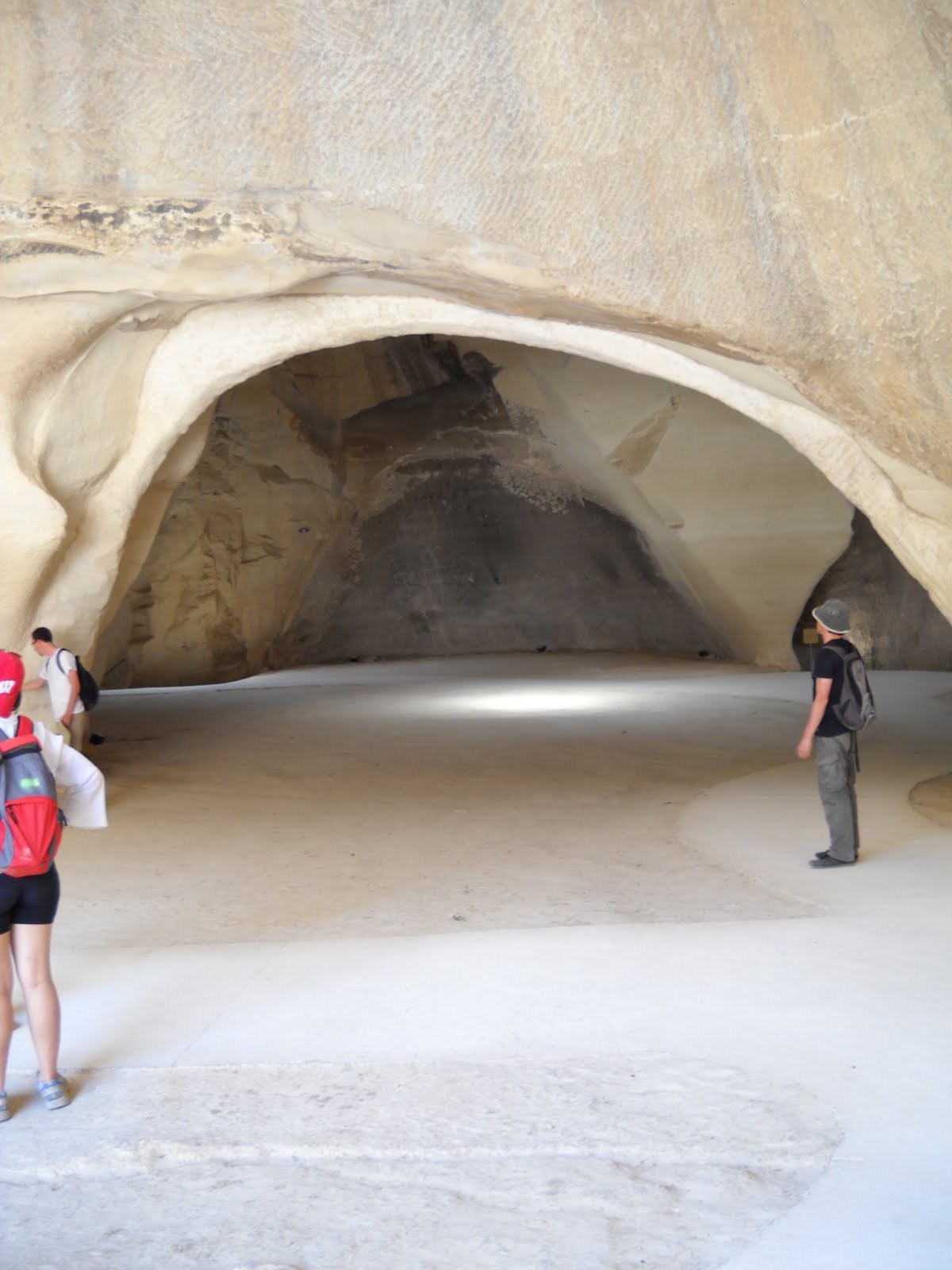
We got back on the bus and drove to another part of this ancient city. A place where the young men of this city would have worked. This area is known as the Bell Caves. These caves are man made. Archaeologists think they were mining lime. They have letters between this city and another one where they complain of the lack of young men. Lime is known to be a toxic substance. We don't know what they were using the lime for. They dug from the top down the bell shaped structure was used to help the caves stay standing. This didn't always work though there were some collapsed caves in the area. 


Here is a perspective picture to give you an idea of how big these caves really are. 


Abstract picture of the openings at the top.


Another large cavern. These caves have great acoustics. We sang a song in Hebrew and danced around in a circle. Our security guard filmed us on her phone and played it back for us. We actually sounded decent. 


Another picture to give you and idea of the scale of this place. 


The word Allah meaning God in Arabic script. 


A cross possibly evidence of the Crusaders presence. 


I solved a mystery on this tour as well.  Remember this picture from one of my May flowers posts? It's a carob tree. You wait until those green seed pods ripen. In my opinion you wait until they are black and look rotten. Then you can eat them. They are very sweet tasting. Our guide said they were food for poor people in ancient times. The seeds are unique in that they always weigh exactly the same amount. So they could be used to weigh precious items like gold, or gem stones. Which is where we get the term carat today. 


Thanks for reading this far. I hope you enjoyed my cave day adventure. 

Monday, August 29, 2011

Night Tour of the Old City

I took this tour way back on August 8th which was Tisha B'av. I wrote about this holiday last year. If you want to refresh your memory you can read about it here. We visited a lot of the same places as the tour last year but I enjoyed having a different guide explain things.

We visited the Holy Sepulchre. Just before we got there the guide stopped us and pointed to a gate. The gate lead to the mosque of Omar. During a siege of Jerusalem in which Omar's army captured Jerusalem, Caliph Omar came to accept the surrender of the city. Omar was invited to pray in the Church of the Holy Sepulchre but he refused. He did not want to endanger the Christian site because everywhere he prayed would be turned into a mosque. I found this story interesting because of the sensitivity it shows for other religions. One of the other students asked a very interesting question at this point. "If the Muslims respected other faith traditions, Why did they build the Dome of the Rock on the Temple Mount?" The answer is because at the time there was nothing but ruins on the Temple Mount it was being used as a garbage dump. So building the Dome of the Rock there was seen as honoring the holiness of the site.

Several pictures I took on this tour are almost the same as last years.  This is one of the alleyways of the Old City. I think it would be rather creepy to walk these streets alone at night.


Here we have the Dome of the Rock and the Western Wall.


Here we have a replica of the menorah used in the Temple. It is not an exact replica because we don't have enough evidence to be certain. This menorah is made of a mixture of gold and zinc where as the Bible says the menorah must be made of pure gold. However pure gold won't hold its shape so we have no idea how they made them. They light this one during Hanukkah.


This is the door to one of the many Yeshivas in town. A Yeshiva is a place where Jewish men go to study the scriptures. You can read more about Yeshiva here. The picture is at a strange angle because there was a streetlight there if I took the picture lined up properly the door was a huge glare. I think this door is beautiful.


From the last post:
Uncle Joe- The cats do come in the buildings and sleep on the benches sometimes.  I am not sure if they do low budget horror films here. I have limited exposure to Israeli cinema. We have watched a few films in my modern Hebrew classes.
As for correcting wikipedia there is a Hebrew version of wiki so native Hebrew speakers might not look up Tel Aviv on the English site to see the mistake.


Friday, August 26, 2011

End of Summer Session II

Summer session two was the first half of level Gimel. Gimel is the third letter in the Hebrew alphabet. Gimel is kind of like the hump level of Modern Hebrew. After completing Gimel you can sign up for classes in the main university that are taught in Hebrew. The level is very challenging with lots of homework. Many nights I would be so tired I would have to go to bed and get up early the next morning in order to finish my homework. I have the next week off then I continue with the second half of Gimel in September.

Over the next week or so I hope to be able to post about some of my adventures from this past month that I was too busy to post about. This morning I went to the store and got a copy of the Jerusalem Post. This newspaper is in English you can check out its website here. This would be a good time to mention that in Israel since the weekend is Friday and Saturday; getting the Friday paper is the equivalent to the Sunday paper back in the states. There is no Saturday paper that I'm aware of because the stores are all closed on Saturday. I'm looking forward to have time this coming week to read for fun.

Hebrew University has had mandatory vacation from August 16th-29th. They had this last year but I don't think I ever posted about it. What this means is during the vacation only Rothberg International School was holding classes. So going through security in the morning they look at your ID more carefully to see the international logo. There was no reason for students not part of the International school to be on campus during this time.

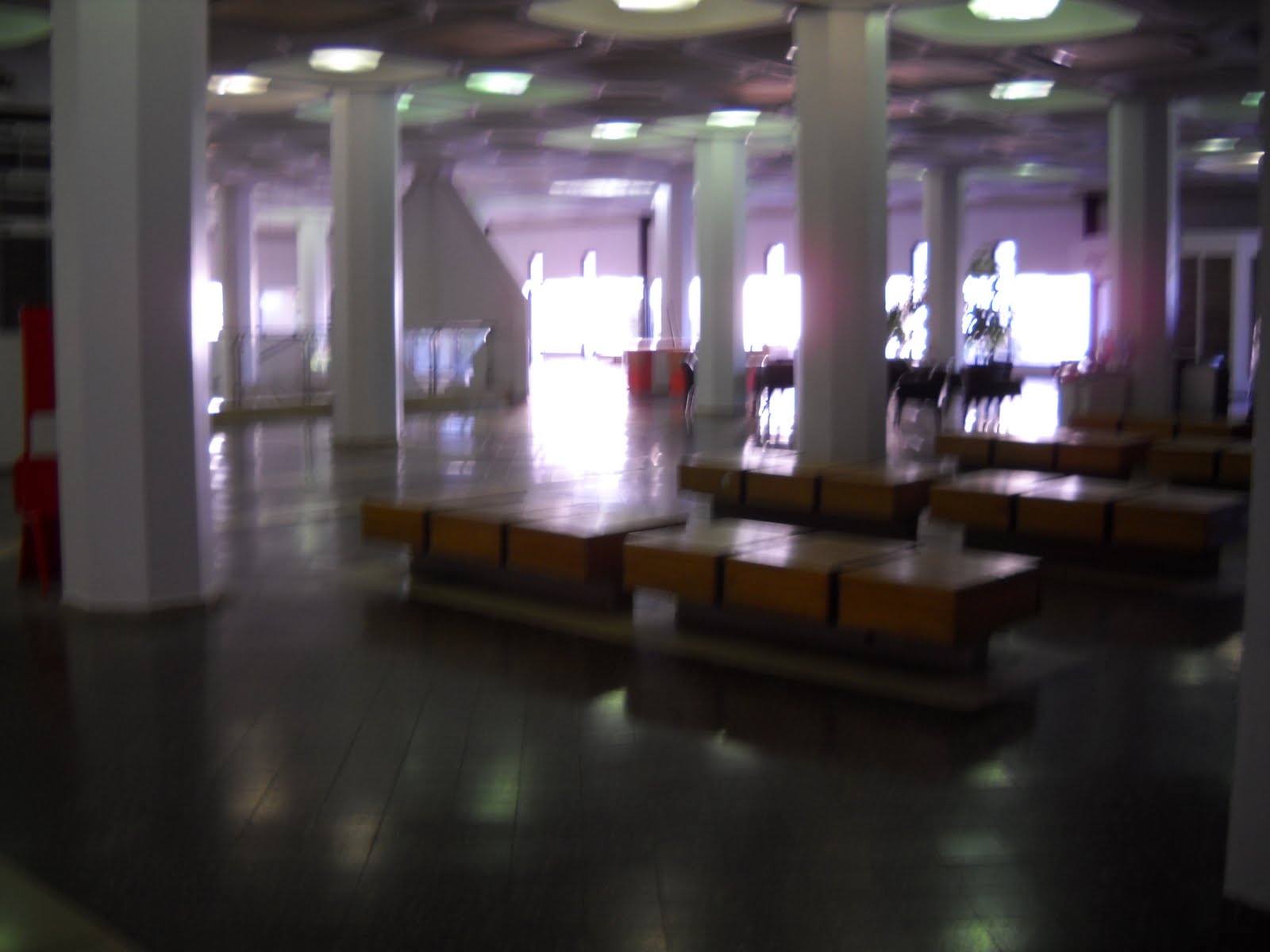
When they say vacation they really mean it. This is just through to entrance from the pedestrian gate. The lights are off in the forum (student center). Normally this cafe is busy in the morning. Sometimes they have the radio on playing some music. You have the sound of the coffee machines. The smell of fresh pastries to tempt you on your way to class. When you're used to all that activity the silence is very strange. This picture is a little brighter because of the light from the skylights. Even though the skylights look more like alien spaceships coming in for a landing in this picture. The black machine to the right of the picture is a cigarette vending machine. I haven't see one of those since I was little. A lot of people smoke here. They don't have any anti-smoking campaigns or surgeon general type warnings.


This is a little further into the forum. There is another closed cafe ahead. To the right there is a staircase leading down to the second level. The lights were not on down there either. However there were workers down there. The sounds of drills and hammers and voices shouting floated up from the dark stairwell.


You might remember this area from a previous post. This is where they were knocking down the wall last summer. Some of these vending machines talk to you when you make your selection and put in your money. It can be rather frightening to have a vending machine speaking Hebrew to you if your not expecting it. Notice the machine in front of the plant. Mentos are popular over here. I've never noticed a mentos machine like this at home but then I don't really like Mentos so I might not have seen them. I had to lighten this in photoshop so you could see the vending machines.


This is the main hub of the forum. There is another cafe to my right. Normally this area would be filled with people. Not as many during to summer as the main semester but still there would be people. I did not alter this photo so the lighting is a little strange.


This picture I'm standing in the same place as the picture above I just turned a little to the left. It really is creepy being in a place normally filled with people that is so empty. I felt like I was in a low budget horror film and someone was going to jump out at me.


Questions from previous posts:
Uncle Joe- Tel aviv sprouted from Jaffa. Two Jewish neighborhoods were started in 1887 and 1891. Tel Aviv was the third in the area, 1909. Tel Aviv was named after the city in Theodore Herzl's book Altneuland (old-new-land). Tel is a word describing something very old and Aviv is the word for Spring (new life).

The Dead Sea scrolls and the Aleppo codex are housed in the same building. The building was designed after the shape of the top of the jars the Dead sea scrolls were found in. That's why the building has such an odd shape.


Sunday, July 31, 2011

Museum Tours

I finished up my first summer session last Monday. The final exam took me five hours to complete. I was very brain dead when I got back to my dorm that afternoon. I had the rest of this past week off and I've been enjoying doing nothing. I've been reading a lot for fun. This Tuesday I start my second Summer session which will be another level of modern Hebrew.

I did two museum tours in July that I haven't told you about yet. This is a kind of catching up post before I start my next class and don't have time to post again.

On July 12th I visited the Holocaust memorial museum.  There were no pictures allowed inside. This picture is looking back at the entrance. It is a quote from the Bible "I will put my breath into you, and you shall live again, and I will set you upon your own soil" Ezekiel 37:14

This was a difficult museum to visit. I thought they did a good job honoring the victims. It was a very moving experience. Lining the walkway to the museum is the Path of the Righteous on either side there are trees planted honoring the non-Jews that risked their lives to save the Jewish people. The building itself is modern in architecture with barren concrete walls. The building is underground symbolizing the darkness of what happened. There is no straight path through the museum it zig zags back and forth. You can see the light at the end of the hallway but you can't reach it without visiting all of the rooms. Our tour was about 2 and a half hours but I think I could easily have spent more time there. I thought they did a good job explaining how the Holocaust began. The first step was burning of books, the rejecting of ideas that did not match their own.

I'm not sure I have the words to describe my experience in this museum. It was very moving and something that I think everyone has to experience for themselves. At one point they had a wall with pictures of 15 men who orchestrated the Final Solution. It was frightening to look at these men who looked so ordinary. But what also struck me was how many of them were doctors, men of higher education. Ordinarily the higher education you have the more tolerant you become but that was not the case here.

In the last room is round with shelves from floor to ceiling they contain the stories of the survivors. They record the names of the victims and what happened to them. They have 4 million names but they will never reach 6 million. In some cases entire villages were wiped out there was no one left to tell their story.

One of the more haunting experiences for me was a photograph of an elderly woman. The guide asked us how old we thought she was. Most of us guessed somewhere in the 60's or 70's. The answer was 26 her experiences had aged her that much. That photo is burned into my mind now because I am currently 26.

The name of the Holocaust museum in Hebrew is Yad Vashem. To an English speaker this doesn't mean  anything. Literally translated it means a hand and a name. It comes from the Bible: "I will give them, in my house and within my walls, a monument and a name better than sons or daughters. I will give them an everlasting name which shall not perish." Isaiah 56:5 Translated this museum gives each victim a name and a place that they will be remembered.

The museum has an excellent website you can find here The website has lots of resources including video testimony of the survivors.


On July 19th I visited the Israel Museum. Again no pictures were allowed inside. This museum is huge, this was my second time visiting. My first time was with my archaeology class last fall. Outside they have a large one acre model of Second Temple Jerusalem that is very impressive. But the main draw of this museum (at least for me) is the Shrine of the Book. This is where you can see parts of the Dead Sea Scrolls. Of course since I study the Bible this was very exciting for me. I couldn't get over how neat the handwriting was and how steady there hand was. Each line was very straight. I can't write straight unless the paper has lines on it. The Dead Sea Scrolls are the oldest known copies of the Hebrew Bible in scroll form. They have a copy of the entire book of Isaiah. However only parts of the collection are on display at any time as they are trying to preserve them. The building they are in is very dark and cold. You can read more about the Dead Sea Scrolls here

Also on display is the Aleppo Codex which is the oldest copy of the Hebrew Bible in book form. This book has a rather interesting history you can read about here.

Tuesday, July 19, 2011

Seventeenth of Tammuz

Today is the 17th of Tammuz on the Jewish calendar this is one of the fast days. This day marks when the walls of the city of Jerusalem were breached by the Romans lead by Titus. Today starts the three week mourning period leading up to Tisha B'Av which I posted about last year. You can read more about the 17th of Tammuz here. I also found this interesting article on wikipedia titled siege of Jerusalem there have been quite a few.

In Biblical Hebrew class today we started to translate Psalm 137 which I thought was appropriate since it is about the Babylonian exile. The Babylonian exile happened after the destruction of the first Temple but I thought it was still a good choice to translate for today. I will probably post my translation of that Psalm sometime next week.

Sorry this post is so short but I have a test tomorrow. I just wanted to post this on the actual day.